
Monday, February 16, 2026
34.1 C
Abuja

Saudi Arabia and Pakistan Forge Mutual Defense Pact  

A New Security Agreement Reflects Growing Gulf Concerns Over U.S. Commitments 

Saudi Arabia and nuclear-armed Pakistan have taken a pivotal step in regional security by formally signing a mutual defense pact on Wednesday, solidifying their decades-old partnership as geopolitical tensions rise across the Middle East. 

The agreement comes at a time when Gulf Arab states increasingly question the reliability of U.S. security guarantees, especially in light of recent events. Notably, Israel’s attack on Qatar last week—targeting political leaders of Hamas during ceasefire discussions in Doha—has further unsettled the region and infuriated Arab countries. The Gaza war has already upended regional dynamics, with Qatar suffering direct strikes twice in a year, once each from Iran and Israel. 

The pact, which was described by a senior Saudi official as the “culmination of years of discussions,” is intended to institutionalize longstanding cooperation rather than respond to any single event or country. “This is not a response to specific countries or specific events but an institutionalization of longstanding and deep cooperation between our two countries,” the official told Reuters, emphasizing its strategic and enduring nature. 

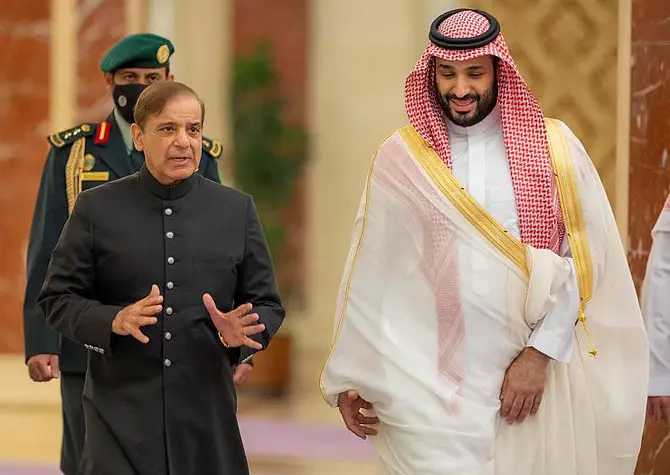
Underlining the significance of the agreement, Pakistani state television broadcast images of Prime Minister Shehbaz Sharif and Saudi Crown Prince Mohammed bin Salman—widely regarded as the kingdom’s de facto ruler—embracing after the signing ceremony. Also present was Pakistan’s influential army chief, Field Marshal Asim Munir.  

The Pakistani prime minister’s office stated, “This agreement, which reflects the shared commitment of both nations to enhance their security and to achieving security and peace in the region and the world, aims to develop aspects of defense cooperation between the two countries and strengthen joint deterrence against any aggression. The agreement states that any aggression against either country shall be considered an aggression against both.” 

In a statement, Pakistan’s Ministry of Foreign Affairs stated that its agreement with Saudi Arabia demonstrates both countries’ commitment to security and regional peace, including a pledge for joint deterrence. The ministry added that any aggression against one nation will be seen as aggression against both. 

The timing of the defense pact is notable, coming just months after Pakistan engaged in a brief military conflict with its rival, India, in May. India’s ministry of external affairs spokesman, Randhir Jaiswal, commented in a post on social media platform X that India is closely monitoring the development and will assess its implications for New Delhi’s security and regional stability. Balancing relations with both South Asian nuclear powers, a senior Saudi official remarked, “Our relationship with India is more robust than it has ever been. We will continue to grow this relationship and seek to contribute to regional peace whichever way we can.” 

The new agreement could potentially shift the strategic calculus in a region where Gulf monarchies, long allied with Washington, are now seeking to manage ties with both Iran and Israel to address persistent security challenges. When asked if Pakistan would be obliged to extend a nuclear umbrella to Saudi Arabia under the new arrangement, the Saudi official responded, “This is a comprehensive defensive agreement that encompasses all military means.” 

Hot this week

President Tinubu Felicitates NNPC Board Chair Musa Kida at 65

President Tinubu Felicitates NNPC Board Chair Musa Kida at 65

We Are Better Together: A Caution to the Advocates of Separation

It must first be clearly stated that the North’s preference for Nigerian unity is not because it is incapable of standing on its own, nor because it is uniquely dependent on the present federal arrangement for its existence. Historically, the North demonstrated a strong capacity for political cohesion and governance under the regional system, where the Caliphate produced the Premier and the Sultanate provided the Governor. With a vast, geographically contiguous landmass, a dominant lingua franca and largely shared religious and cultural frameworks, a substantial part of Northern Nigeria has historically functioned as a coherent political space.

PDP Disputes Ibadan Court, Affirms NWC Validity 

The PDP chairman noted that the Ibadan ruling was only one of several judgments of the Federal High Court on the matter and that the core issues were already before the Court of Appeal. He described the decision as “technically academic” pending an authoritative pronouncement by the appellate court. Turaki reassured party members that the National Working Committee produced by the Ibadan Convention remained “legally intact and firmly in place,” and committed to what he described as the party’s ongoing rebirth.

A Setback for Wike in PDP Crisis 

While the Supreme Court’s earlier intervention briefly revived Anyanwu’s standing, Tuesday’s dismissal signals that legal victories alone may no longer be enough to secure long-term control. The struggle within the PDP is increasingly shifting from courtrooms to internal political negotiations, and in that arena, the momentum appears to be slipping away from the Wike camp.

NNPC Ltd. Debt: FG Forgave Interest, Not Principal, Officials Say 

Fresh details have emerged that challenge the widespread belief that the...

Topics

President Tinubu Felicitates NNPC Board Chair Musa Kida at 65

President Tinubu Felicitates NNPC Board Chair Musa Kida at 65

We Are Better Together: A Caution to the Advocates of Separation

It must first be clearly stated that the North’s preference for Nigerian unity is not because it is incapable of standing on its own, nor because it is uniquely dependent on the present federal arrangement for its existence. Historically, the North demonstrated a strong capacity for political cohesion and governance under the regional system, where the Caliphate produced the Premier and the Sultanate provided the Governor. With a vast, geographically contiguous landmass, a dominant lingua franca and largely shared religious and cultural frameworks, a substantial part of Northern Nigeria has historically functioned as a coherent political space.

PDP Disputes Ibadan Court, Affirms NWC Validity 

The PDP chairman noted that the Ibadan ruling was only one of several judgments of the Federal High Court on the matter and that the core issues were already before the Court of Appeal. He described the decision as “technically academic” pending an authoritative pronouncement by the appellate court. Turaki reassured party members that the National Working Committee produced by the Ibadan Convention remained “legally intact and firmly in place,” and committed to what he described as the party’s ongoing rebirth.

A Setback for Wike in PDP Crisis 

While the Supreme Court’s earlier intervention briefly revived Anyanwu’s standing, Tuesday’s dismissal signals that legal victories alone may no longer be enough to secure long-term control. The struggle within the PDP is increasingly shifting from courtrooms to internal political negotiations, and in that arena, the momentum appears to be slipping away from the Wike camp.

NNPC Ltd. Debt: FG Forgave Interest, Not Principal, Officials Say 

Fresh details have emerged that challenge the widespread belief that the...

No Terrorists Were Killed in U.S. Strike on ‘ISIS’ in Nigeria 

Abu Jabo dismissed reports that terrorists were killed in the strike, stressing that Jabo has no history of insurgency or bandit activity. “There are no terrorists here. There are no Christians here either. Jabo is a peaceful, Muslim community. We do not have security problems,” he added. Local sources also dispute claims that the area harbors ISIS-linked elements, describing Jabo as a quiet farming settlement with no record of extremist activity.

Trump: U.S. Hit Terror Targets in Nigeria 

In a strongly worded statement posted on his verified social media account, Trump said the United States, acting under his direction as Commander-in-Chief, had launched “powerful and deadly” strikes against what he described as ISIS-linked terrorists operating in Northwest Nigeria. He claimed the operation was in response to the killing of Christians and warned of further military action if such attacks continued. 

NNPC Limited: Early Signals from the Kida–Ojulari Era 

As a non-executive chairman with decades of industry experience, Engr. Kida’s influence lies less in operational detail and more in direction-setting and discipline. The reconstituted board signals a renewed emphasis on corporate governance, professionalism and alignment with the spirit of the PIA, that NNPC Limited should operate as a business, not a government department. 
spot_img

Related Articles

Popular Categories

spot_imgspot_img