

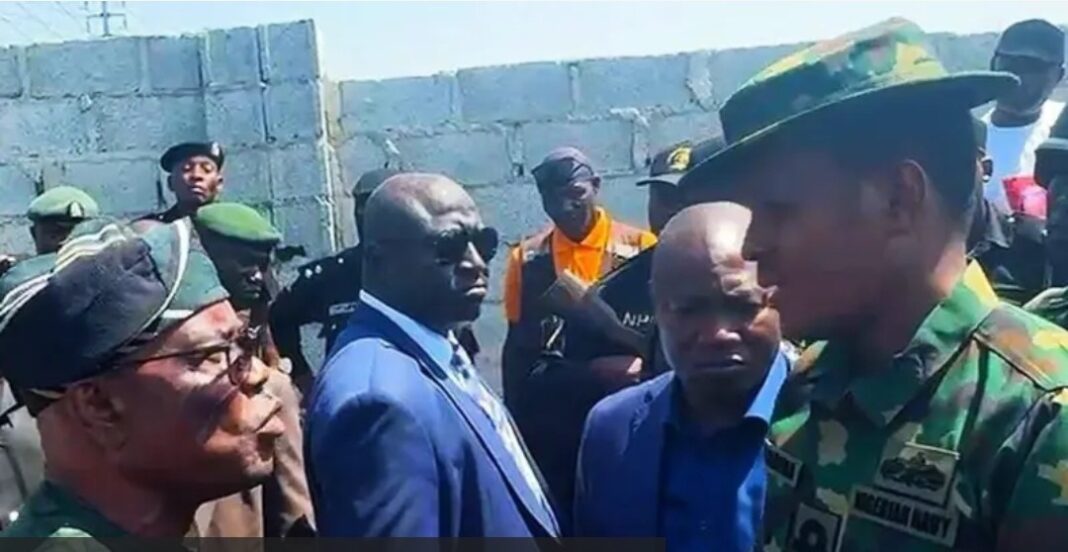

Lately, there has been a resurgence of military interventions in politics, unsettling democratic gains and shaking institutional foundations in several African nations. Against this backdrop, the shameful altercation between the Minister of the Federal Capital Territory (FCT) Nyesom Wike and Navy Lt. AM Yerima over a disputed piece of land in Gaduwa District in Abuja is more than a domestic episode. It mirrors a wider anxiety about the fragility of democratic norms, the sanctity of civil-military boundaries, and the health of governance in volatile times.
At the heart of the Wike-Yerima incident lies a tension between elected authority and military discipline. When a senior government official publicly berates a uniformed officer, as Wike did, it sends ambiguous messages about the respect accorded to the chain of command and the rule of law.
In separate social media posts, former chief of army staff, Gen. TY Buratai and a former minister of aviation, Osita Chidoka underlined the danger of undermining institutional processes and discipline.
Commenting on Wike’s behavior, Gen. Buratai wrote: “[Wike’s] verbal assault on a military officer in uniform is an act of profound indiscipline that strikes at the core of our nation’s command and control structure. It deliberately undermines the chain of command, disrespects the authority of the Commander-in-Chief, and grievously wounds the morale of every individual who serves under the Nigerian flag. Such actions erode the very foundation of discipline upon which our national security apparatus stands.”
Gen. Buratai added that this cannot be dismissed as political theatre. “It is a reckless endangerment of national order. This action by Wike is clearly an indication of undermining the federal government’s authority.”
In an era where respect for constitutional order is paramount, such confrontations risk eroding the invisible wall that separates civilian oversight from military autonomy.
If these boundaries become porous, where political figures act impulsively and military officers are drawn into public disputes, the risk of institutional confusion grows. This confusion can foster environments in which military actors feel compelled or even justified to intervene in governance, especially if they perceive that civilian leaders themselves fail to respect process or discipline.
Recent coups in Mali, Burkina Faso, Niger, and Madagascar have demonstrated how fragile democratic institutions can be. Often, these upheavals are precipitated by a breakdown in trust between civilian authorities and the armed forces, heightened by perceptions of lawlessness, corruption, or disrespect. When high-ranking ministers engage in confrontations that undermine the dignity of the officer corps and confuse the roles of government institutions, they inadvertently provide fodder for those who argue that the military is better positioned to restore ‘order.’
The Nigerian Armed Forces, as Gen. Buratai emphasizes, hold a critical position in safeguarding national security and stability. Any sign that civilian leaders are willing to bypass due process or disrupt the established chain of command not only weakens morale but can embolden ambitious officers, eroding the democratic principle that the military remains subordinate to civilian rule.
Should such incidents become normalized, where ministers or other political actors treat the armed forces with disrespect or disregard established procedures, the precedent set is dangerous. It risks creating a culture where authority is exercised through direct conflict rather than due process, and where the army might feel compelled to ‘correct’ perceived excesses or failings of civilian leadership, echoing the rationale often cited in coup announcements elsewhere on the continent.
When considering Africa’s present political landscape, the dispute between Wike and Navy Lt. Yerima serves as a timely caution. It underlines how critical it is for Nigeria’s leaders to enforce institutional boundaries, respect legal frameworks, and preserve disciplined relations between civilians and the military. Actions such as making public apologies, conducting open investigations, and recommitting to procedures are more than just formalities—they help safeguard against potential military involvement and protect democratic institutions. Most importantly, President Bola Tinubu must reconsider his alliance with Wike, who increasingly seems to be a problematic figure within his administration.
This dispute is not an isolated issue; it reflects wider continental concerns regarding the stability of democratic institutions. In an era where Africa faces renewed risks from military coups, it is imperative for Nigeria’s leadership to recognize that maintaining the dignity of office, a clear chain of command, and respect for due process are crucial in mitigating vulnerabilities that may be exploited. Maintaining vigilance, exercising humility, and ensuring strict compliance with the law are key measures to safeguard against democratic regression.


 Nyesom Wike and Navy Lt. AM Yerima over a disputed piece of land in Gaduwa District in Abuja is more than a domestic episode. It mirrors a wider anxiety about the fragility of democratic norms, the sanctity of civil-military boundaries, and the health of governance in volatile times.)