
Saudi Arabia and Pakistan Forge Mutual Defense Pact  

A New Security Agreement Reflects Growing Gulf Concerns Over U.S. Commitments 

Saudi Arabia and nuclear-armed Pakistan have taken a pivotal step in regional security by formally signing a mutual defense pact on Wednesday, solidifying their decades-old partnership as geopolitical tensions rise across the Middle East. 

The agreement comes at a time when Gulf Arab states increasingly question the reliability of U.S. security guarantees, especially in light of recent events. Notably, Israel’s attack on Qatar last week—targeting political leaders of Hamas during ceasefire discussions in Doha—has further unsettled the region and infuriated Arab countries. The Gaza war has already upended regional dynamics, with Qatar suffering direct strikes twice in a year, once each from Iran and Israel. 

The pact, which was described by a senior Saudi official as the “culmination of years of discussions,” is intended to institutionalize longstanding cooperation rather than respond to any single event or country. “This is not a response to specific countries or specific events but an institutionalization of longstanding and deep cooperation between our two countries,” the official told Reuters, emphasizing its strategic and enduring nature. 

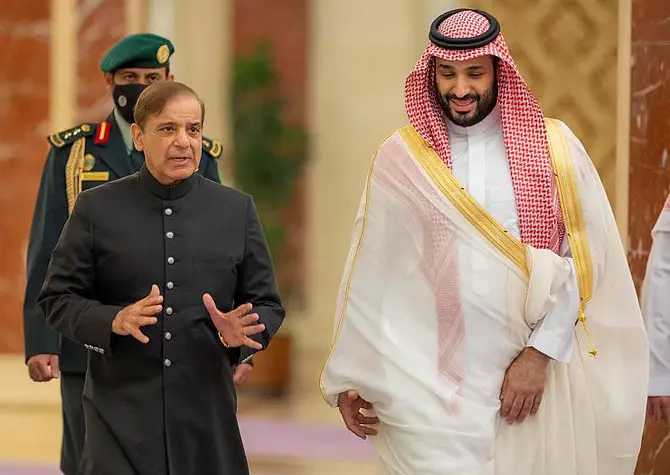
Underlining the significance of the agreement, Pakistani state television broadcast images of Prime Minister Shehbaz Sharif and Saudi Crown Prince Mohammed bin Salman—widely regarded as the kingdom’s de facto ruler—embracing after the signing ceremony. Also present was Pakistan’s influential army chief, Field Marshal Asim Munir.  

The Pakistani prime minister’s office stated, “This agreement, which reflects the shared commitment of both nations to enhance their security and to achieving security and peace in the region and the world, aims to develop aspects of defense cooperation between the two countries and strengthen joint deterrence against any aggression. The agreement states that any aggression against either country shall be considered an aggression against both.” 

In a statement, Pakistan’s Ministry of Foreign Affairs stated that its agreement with Saudi Arabia demonstrates both countries’ commitment to security and regional peace, including a pledge for joint deterrence. The ministry added that any aggression against one nation will be seen as aggression against both. 

The timing of the defense pact is notable, coming just months after Pakistan engaged in a brief military conflict with its rival, India, in May. India’s ministry of external affairs spokesman, Randhir Jaiswal, commented in a post on social media platform X that India is closely monitoring the development and will assess its implications for New Delhi’s security and regional stability. Balancing relations with both South Asian nuclear powers, a senior Saudi official remarked, “Our relationship with India is more robust than it has ever been. We will continue to grow this relationship and seek to contribute to regional peace whichever way we can.” 

The new agreement could potentially shift the strategic calculus in a region where Gulf monarchies, long allied with Washington, are now seeking to manage ties with both Iran and Israel to address persistent security challenges. When asked if Pakistan would be obliged to extend a nuclear umbrella to Saudi Arabia under the new arrangement, the Saudi official responded, “This is a comprehensive defensive agreement that encompasses all military means.” 

Hot this week

What They Never Told You: Ayatollah Khomeini Was a Great Jurist, Not a Fanatic

The West gave Iran a name — theocracy — and buried the reality beneath it. They never told you that Khomeini spent decades mastering one of the most rigorous legal traditions in human history, or that he built a constitutional republic ratified by 98 percent of the Iranian people in a free referendum. A nation of fanatics can be bombed with a clear conscience. A constitutional republic of 93 million people, founded by a supremely gifted jurist, is harder to dispose of.

‘We Won’t Be Silenced’: ADC Rejects Court-Ordered Deregistration

Abdullahi said: We did not expect the level of judicial rascality that was demonstrated. When a Court of Appeal says stay proceedings until October 27 and a lower court goes ahead to deliver judgment on the same matter, it is bizarre and dangerous."

Sheikh Gumi and the Case for Dialogue

It is against this background that I offer my views on the issues of banditry and kidnappings, particularly in northern Nigeria. My perspective is informed by knowledge acquired during my graduate studies at the Fletcher School of Law and Diplomacy, Tufts University, in the United States. Two courses, in particular, shaped my understanding of conflicts and their resolution. The first was International Security Studies, taught by Professor Richard Shultz, a consultant to the Pentagon. The second was International Negotiation, taught by Professor Diana Chigas, a member of the team that helped negotiate the end of apartheid in South Africa.

June 12: Democracy’s Sacred Mandate and Nigeria’s Unfinished Journey

Democracy has delivered some notable gains. The country has witnessed peaceful transfers of power, expanded political participation, a more vibrant media landscape, and greater civic engagement. These achievements should not be dismissed. They are evidence that democratic governance, despite its imperfections, remains preferable to military rule. However, democracy cannot survive on political rituals alone. For millions of Nigerians battling insecurity, unemployment, poverty, inflation, and inadequate infrastructure, democracy must mean more than periodic elections.

Atiku Picks Amaechi as Running Mate in Strategic Move

In a move that could significantly reshape Nigeria's political landscape ahead of the next presidential election, the presidential candidate of the African Democratic Congress (ADC), Alhaji Atiku Abubakar, has nominated former Minister of Transportation, Chief Chibuike Rotimi Amaechi, as his running mate.

Topics

What They Never Told You: Ayatollah Khomeini Was a Great Jurist, Not a Fanatic

The West gave Iran a name — theocracy — and buried the reality beneath it. They never told you that Khomeini spent decades mastering one of the most rigorous legal traditions in human history, or that he built a constitutional republic ratified by 98 percent of the Iranian people in a free referendum. A nation of fanatics can be bombed with a clear conscience. A constitutional republic of 93 million people, founded by a supremely gifted jurist, is harder to dispose of.

‘We Won’t Be Silenced’: ADC Rejects Court-Ordered Deregistration

Abdullahi said: We did not expect the level of judicial rascality that was demonstrated. When a Court of Appeal says stay proceedings until October 27 and a lower court goes ahead to deliver judgment on the same matter, it is bizarre and dangerous."

Sheikh Gumi and the Case for Dialogue

It is against this background that I offer my views on the issues of banditry and kidnappings, particularly in northern Nigeria. My perspective is informed by knowledge acquired during my graduate studies at the Fletcher School of Law and Diplomacy, Tufts University, in the United States. Two courses, in particular, shaped my understanding of conflicts and their resolution. The first was International Security Studies, taught by Professor Richard Shultz, a consultant to the Pentagon. The second was International Negotiation, taught by Professor Diana Chigas, a member of the team that helped negotiate the end of apartheid in South Africa.

June 12: Democracy’s Sacred Mandate and Nigeria’s Unfinished Journey

Democracy has delivered some notable gains. The country has witnessed peaceful transfers of power, expanded political participation, a more vibrant media landscape, and greater civic engagement. These achievements should not be dismissed. They are evidence that democratic governance, despite its imperfections, remains preferable to military rule. However, democracy cannot survive on political rituals alone. For millions of Nigerians battling insecurity, unemployment, poverty, inflation, and inadequate infrastructure, democracy must mean more than periodic elections.

Atiku Picks Amaechi as Running Mate in Strategic Move

In a move that could significantly reshape Nigeria's political landscape ahead of the next presidential election, the presidential candidate of the African Democratic Congress (ADC), Alhaji Atiku Abubakar, has nominated former Minister of Transportation, Chief Chibuike Rotimi Amaechi, as his running mate.

Three Killed as Gunmen Raid Kogi School

The Kogi State Police Command said the attackers arrived in large numbers, travelling on about 40 motorcycles, and targeted the school and nearby surroundings in what authorities believe may have been an attempt to carry out kidnappings.

Kwankwaso Weighs NDC Exit as Candidate Purge Deepens Party Crisis

Amid the growing controversy, there is a call urging Kwankwaso to leave the NDC if he believes he is being unfairly treated by the party leadership. Supporters of Kwankwaso say he should pursue his political ambitions on another platform if he feels constrained, marginalized, or denied a fair role within the party.

Sheikh Gumi: An Asset Nigeria Should Not Ignore

For many years, Gumi has attracted criticism because of his contacts with bandits. Some commentators have accused him of being too sympathetic to them. Others have questioned why he meets with them in their forest hideouts. But instead of seeing him as part of the problem, Nigerians should ask whether he can be part of the solution.
spot_img

Related Articles

Popular Categories

spot_imgspot_img