
Wednesday, May 20, 2026
24.5 C
Abuja

Implications of the Wike-Yerima Altercation

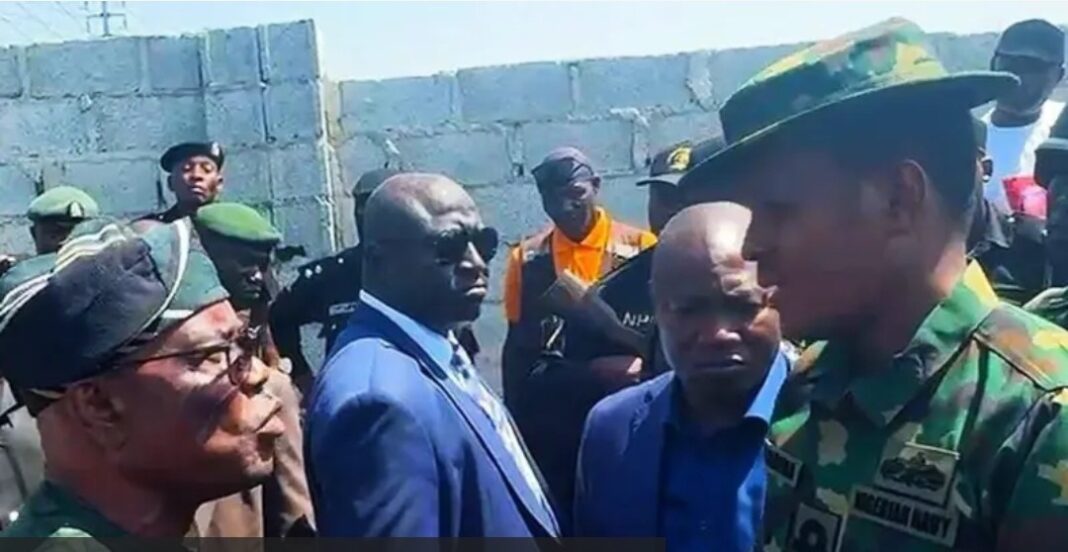
Lately, there has been a resurgence of military interventions in politics, unsettling democratic gains and shaking institutional foundations in several African nations. Against this backdrop, the shameful altercation between the Minister of the Federal Capital Territory (FCT) Nyesom Wike and Navy Lt. AM Yerima over a disputed piece of land in Gaduwa District in Abuja is more than a domestic episode. It mirrors a wider anxiety about the fragility of democratic norms, the sanctity of civil-military boundaries, and the health of governance in volatile times.

At the heart of the Wike-Yerima incident lies a tension between elected authority and military discipline. When a senior government official publicly berates a uniformed officer, as Wike did, it sends ambiguous messages about the respect accorded to the chain of command and the rule of law.

In separate social media posts, former chief of army staff, Gen. TY Buratai and a former minister of aviation, Osita Chidoka underlined the danger of undermining institutional processes and discipline.

Commenting on Wike’s behavior, Gen. Buratai wrote: “[Wike’s] verbal assault on a military officer in uniform is an act of profound indiscipline that strikes at the core of our nation’s command and control structure. It deliberately undermines the chain of command, disrespects the authority of the Commander-in-Chief, and grievously wounds the morale of every individual who serves under the Nigerian flag. Such actions erode the very foundation of discipline upon which our national security apparatus stands.”

Gen. Buratai added that this cannot be dismissed as political theatre. “It is a reckless endangerment of national order. This action by Wike is clearly an indication of undermining the federal government’s authority.”

 In an era where respect for constitutional order is paramount, such confrontations risk eroding the invisible wall that separates civilian oversight from military autonomy.

If these boundaries become porous, where political figures act impulsively and military officers are drawn into public disputes, the risk of institutional confusion grows. This confusion can foster environments in which military actors feel compelled or even justified to intervene in governance, especially if they perceive that civilian leaders themselves fail to respect process or discipline.

Recent coups in Mali, Burkina Faso, Niger, and Madagascar have demonstrated how fragile democratic institutions can be. Often, these upheavals are precipitated by a breakdown in trust between civilian authorities and the armed forces, heightened by perceptions of lawlessness, corruption, or disrespect. When high-ranking ministers engage in confrontations that undermine the dignity of the officer corps and confuse the roles of government institutions, they inadvertently provide fodder for those who argue that the military is better positioned to restore ‘order.’

The Nigerian Armed Forces, as Gen. Buratai emphasizes, hold a critical position in safeguarding national security and stability. Any sign that civilian leaders are willing to bypass due process or disrupt the established chain of command not only weakens morale but can embolden ambitious officers, eroding the democratic principle that the military remains subordinate to civilian rule.

Should such incidents become normalized, where ministers or other political actors treat the armed forces with disrespect or disregard established procedures, the precedent set is dangerous. It risks creating a culture where authority is exercised through direct conflict rather than due process, and where the army might feel compelled to ‘correct’ perceived excesses or failings of civilian leadership, echoing the rationale often cited in coup announcements elsewhere on the continent.

When considering Africa’s present political landscape, the dispute between Wike and Navy Lt. Yerima serves as a timely caution. It underlines how critical it is for Nigeria’s leaders to enforce institutional boundaries, respect legal frameworks, and preserve disciplined relations between civilians and the military. Actions such as making public apologies, conducting open investigations, and recommitting to procedures are more than just formalities—they help safeguard against potential military involvement and protect democratic institutions. Most importantly, President Bola Tinubu must reconsider his alliance with Wike, who increasingly seems to be a problematic figure within his administration.

This dispute is not an isolated issue; it reflects wider continental concerns regarding the stability of democratic institutions. In an era where Africa faces renewed risks from military coups, it is imperative for Nigeria’s leadership to recognize that maintaining the dignity of office, a clear chain of command, and respect for due process are crucial in mitigating vulnerabilities that may be exploited. Maintaining vigilance, exercising humility, and ensuring strict compliance with the law are key measures to safeguard against democratic regression.


Hot this week

NNPC Limited Alerts Public to False Claims Over Refinery Scrap Sales 

 In its release signed by Andy Odeh, its Chief Corporate Communications Officer, the company clarified that it has not authorized or issued requests for bids, tenders, expressions of interest, or approvals concerning the sale of scrap materials, refinery components, or other items from its warehouses or inventories. The company underscored that any information circulating in public forums suggesting otherwise is inaccurate and should be disregarded. 

Supreme Court Cancels PDP Convention; BoT Assumes Leadership 

In a dramatic turn on Thursday, the apex court invalidated the November 15–16, 2025 convention held in Ibadan, which produced the Kabiru Tanimu Turaki-led National Working Committee (NWC). The ruling also upheld the suspension of key party officials, including Samuel Anyanwu, Umar Bature and Kamaldeen Ajibade. 

Opposition Parties Unite in Ibadan, Vow Single Candidate for 2027

Opposition political parties in Nigeria on Saturday resolved to form a united front ahead of the 2027 general elections, including plans to field a single presidential candidate, as they accused the ruling All Progressives Congress (APC) of undermining democracy. The resolution, contained in a communiqué issued at the end of a national summit in Ibadan, warned against what participants described as attempts by the APC to impose a one-party state on the country. The parties pledged to “resist all machinations” that could threaten Nigeria’s multi-party system.

White House Correspondents’ Dinner Interrupted by Shooting Incident 

Just after 8:30 p.m., while President Trump and Melania Trump were engaging with entertainer Oz Pearlman on stage, a man, later identified as Cole Tomas Allen, sprinted through a security checkpoint carrying a shotgun. Secret Service agents pursued and exchanged gunfire with him, quickly subduing Allen before he could reach the ballroom. Inside, guests enjoying their salads were startled by loud, cracking sounds, leading to confusion and panic as armed law enforcement swept in and shouted for everyone to get down. 

President Tinubu Felicitates NNPC Board Chair Musa Kida at 65

President Tinubu Felicitates NNPC Board Chair Musa Kida at 65

Topics

NNPC Limited Alerts Public to False Claims Over Refinery Scrap Sales 

 In its release signed by Andy Odeh, its Chief Corporate Communications Officer, the company clarified that it has not authorized or issued requests for bids, tenders, expressions of interest, or approvals concerning the sale of scrap materials, refinery components, or other items from its warehouses or inventories. The company underscored that any information circulating in public forums suggesting otherwise is inaccurate and should be disregarded. 

Supreme Court Cancels PDP Convention; BoT Assumes Leadership 

In a dramatic turn on Thursday, the apex court invalidated the November 15–16, 2025 convention held in Ibadan, which produced the Kabiru Tanimu Turaki-led National Working Committee (NWC). The ruling also upheld the suspension of key party officials, including Samuel Anyanwu, Umar Bature and Kamaldeen Ajibade. 

Opposition Parties Unite in Ibadan, Vow Single Candidate for 2027

Opposition political parties in Nigeria on Saturday resolved to form a united front ahead of the 2027 general elections, including plans to field a single presidential candidate, as they accused the ruling All Progressives Congress (APC) of undermining democracy. The resolution, contained in a communiqué issued at the end of a national summit in Ibadan, warned against what participants described as attempts by the APC to impose a one-party state on the country. The parties pledged to “resist all machinations” that could threaten Nigeria’s multi-party system.

White House Correspondents’ Dinner Interrupted by Shooting Incident 

Just after 8:30 p.m., while President Trump and Melania Trump were engaging with entertainer Oz Pearlman on stage, a man, later identified as Cole Tomas Allen, sprinted through a security checkpoint carrying a shotgun. Secret Service agents pursued and exchanged gunfire with him, quickly subduing Allen before he could reach the ballroom. Inside, guests enjoying their salads were startled by loud, cracking sounds, leading to confusion and panic as armed law enforcement swept in and shouted for everyone to get down. 

President Tinubu Felicitates NNPC Board Chair Musa Kida at 65

President Tinubu Felicitates NNPC Board Chair Musa Kida at 65

We Are Better Together: A Caution to the Advocates of Separation

It must first be clearly stated that the North’s preference for Nigerian unity is not because it is incapable of standing on its own, nor because it is uniquely dependent on the present federal arrangement for its existence. Historically, the North demonstrated a strong capacity for political cohesion and governance under the regional system, where the Caliphate produced the Premier and the Sultanate provided the Governor. With a vast, geographically contiguous landmass, a dominant lingua franca and largely shared religious and cultural frameworks, a substantial part of Northern Nigeria has historically functioned as a coherent political space.

PDP Disputes Ibadan Court, Affirms NWC Validity 

The PDP chairman noted that the Ibadan ruling was only one of several judgments of the Federal High Court on the matter and that the core issues were already before the Court of Appeal. He described the decision as “technically academic” pending an authoritative pronouncement by the appellate court. Turaki reassured party members that the National Working Committee produced by the Ibadan Convention remained “legally intact and firmly in place,” and committed to what he described as the party’s ongoing rebirth.

A Setback for Wike in PDP Crisis 

While the Supreme Court’s earlier intervention briefly revived Anyanwu’s standing, Tuesday’s dismissal signals that legal victories alone may no longer be enough to secure long-term control. The struggle within the PDP is increasingly shifting from courtrooms to internal political negotiations, and in that arena, the momentum appears to be slipping away from the Wike camp.
spot_img

Related Articles

Popular Categories

spot_imgspot_img