

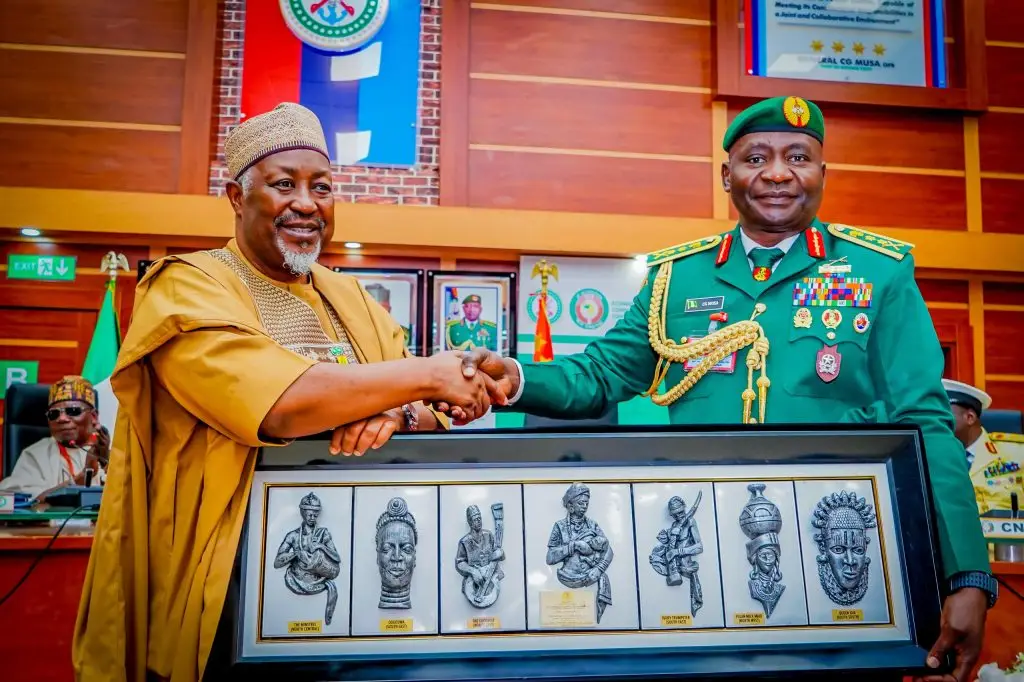

Nigeria’s Minister of Defense, Alhaji Mohammed Badaru Abubakar, has resigned from his position with immediate effect, citing health reasons. In a letter dated December 1, 2025, Badaru formally communicated his decision to President Bola Tinubu, who promptly accepted the resignation and publicly thanked the outgoing minister for his service to the nation. The president is expected to inform the Senate of Badaru’s successor later this week.
Badaru Abubakar, 63, previously served as the two-term governor of Jigawa state from 2015 to 2023 before being appointed minister of defense on August 21, 2023, by President Tinubu. His resignation comes at a critical time, as President Tinubu recently declared a national security emergency, pledging to elaborate on its scope in the coming days.
Credible sources indicate that President Tinubu is set to nominate General Christopher Musa, the immediate past Chief of Defense Staff, to replace Badaru as defense minister. The move follows calls for the inclusion of a seasoned ex-military officer in the cabinet amid heightened security challenges. On Monday evening, General Musa was seen arriving at the Presidential Villa, where he met with the president in what observers describe as a pivotal encounter. This marks Musa’s first public meeting with Tinubu since his retirement on October 24, 2025.
The resignation follows a period of intense public and media scrutiny over Badaru’s handling of Nigeria’s persistent security crises. An editorial published by The Punch was particularly scathing, branding Badaru as “utterly unfit” to oversee the nation’s defense apparatus. The editorial pointed to a recent BBC Hausa interview in which Badaru appeared to struggle with articulating effective strategies against terrorist groups hiding in Nigeria’s forests. His comments about the Nigerian Air Force’s inability to target terrorists because “some hideouts are too thick for bombs to penetrate” were described as “confusing, contradictory, and self-deprecating.”
The editorial further criticized Badaru’s perceived ignorance of modern military technology and called his statements an embarrassment to both the ministry and the armed forces. It argued that excuses about inaccessible terrorist hideouts only serve to justify ongoing failures in addressing a crisis that has, according to government figures, left over 100,000 Nigerians dead and more than two million displaced since 2009.
The Punch editorial emphasized the need for the Nigerian government to seek international assistance and adopt advanced surveillance and weapon systems capable of penetrating even the most challenging terrain. It also urged President Tinubu to appoint a defense minister with a military background; a criterion General Musa meets.
In addition to Badaru, the editorial criticized Bello Matawalle, the deputy defense minister, over alleged past associations with bandit groups during his time as Zamfara governor, accusations he has denied. The editorial concluded that the current security emergency requires decisive leadership, advanced technology, and an end to “lame justifications” for inaction.
As President Tinubu prepares to announce a new defense minister, the nation watches closely for signs of a shift in strategy to address mounting insecurity. The expected nomination of General Musa signals a possible pivot toward more experienced military leadership at a time when public confidence in government responses to terrorism and banditry has been deeply shaken.