
Monday, February 16, 2026
39.1 C
Abuja

A Setback for Wike in PDP Crisis 

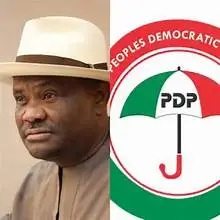
The dismissal on Tuesday of a suit filed by Samuel Anyanwu, a key ally of Nyesom Wike, has dealt a fresh blow to the former Rivers State governor’s influence in the protracted crisis rocking the Peoples Democratic Party (PDP). 

At the Federal High Court in Abuja, Justice Mohammed Umar struck out Anyanwu’s case after his own lawyer admitted that his tenure as national secretary expired in December 2025. The court’s ruling, though procedural, carries deep political implications for the balance of power within the opposition party. 

The suit sought judicial validation of Anyanwu as PDP national secretary and named the party itself, the Independent National Electoral Commission (INEC), and rival party officials, including Umar Damagun and Sunday Udeh-Okoye, as defendants. 

However, the dramatic turning point came when Anyanwu’s counsel, U. C. Njemanze-Aku, told the court that continuing the case would be improper since events had overtaken it. The admission effectively pulled the rug from under the suit, prompting INEC and other defendants to argue that it should never have been filed in the first place. 

Justice Umar agreed to dismiss the case but declined to impose costs, noting that the delay and confusion were not attributable to any single party. 

Beyond the courtroom technicalities, the ruling underscores a deeper political reality: the Wike-backed faction within the PDP is losing critical legal ground in its bid to dominate the party’s national structure. 

Anyanwu’s position as national secretary has long been central to the internal power tussle. Control of the office means control of party administration, correspondence with INEC, and, crucially, influence over primaries and congresses. For Wike, who has been locked in a bitter rivalry with other PDP power blocs, retaining allies in strategic positions has been a core strategy. 

The Abuja court’s decision now weakens that strategy by effectively acknowledging that Anyanwu’s tenure has lapsed, regardless of earlier judicial victories. 

The PDP secretaryship dispute dates back to Anyanwu’s decision to vacate the office to contest the 2023 Imo governorship election. His defeat triggered attempts to return to the secretariat, setting off factional battles that pitched him against Mr. Udeh-Okoye. 

In December 2024, the Court of Appeal in Enugu affirmed rulings removing Anyanwu and recognising Udeh-Okoye as secretary. Although the Supreme Court later overturned those judgments in March 2025, the decision failed to restore lasting peace. Competing factions continued to assert authority, forcing Anyanwu to return to court for further clarification. 

That latest effort has now ended abruptly, and unfavorably. 

For the PDP, the ruling deepens uncertainty at a time when the party needs cohesion to reposition itself nationally. For Wike, it represents another setback in a series of legal and political reversals that have limited his leverage within the opposition. 

While the Supreme Court’s earlier intervention briefly revived Anyanwu’s standing, Tuesday’s dismissal signals that legal victories alone may no longer be enough to secure long-term control. The struggle within the PDP is increasingly shifting from courtrooms to internal political negotiations, and in that arena, the momentum appears to be slipping away from the Wike camp. 

Hot this week

President Tinubu Felicitates NNPC Board Chair Musa Kida at 65

President Tinubu Felicitates NNPC Board Chair Musa Kida at 65

We Are Better Together: A Caution to the Advocates of Separation

It must first be clearly stated that the North’s preference for Nigerian unity is not because it is incapable of standing on its own, nor because it is uniquely dependent on the present federal arrangement for its existence. Historically, the North demonstrated a strong capacity for political cohesion and governance under the regional system, where the Caliphate produced the Premier and the Sultanate provided the Governor. With a vast, geographically contiguous landmass, a dominant lingua franca and largely shared religious and cultural frameworks, a substantial part of Northern Nigeria has historically functioned as a coherent political space.

PDP Disputes Ibadan Court, Affirms NWC Validity 

The PDP chairman noted that the Ibadan ruling was only one of several judgments of the Federal High Court on the matter and that the core issues were already before the Court of Appeal. He described the decision as “technically academic” pending an authoritative pronouncement by the appellate court. Turaki reassured party members that the National Working Committee produced by the Ibadan Convention remained “legally intact and firmly in place,” and committed to what he described as the party’s ongoing rebirth.

NNPC Ltd. Debt: FG Forgave Interest, Not Principal, Officials Say 

Fresh details have emerged that challenge the widespread belief that the...

No Terrorists Were Killed in U.S. Strike on ‘ISIS’ in Nigeria 

Abu Jabo dismissed reports that terrorists were killed in the strike, stressing that Jabo has no history of insurgency or bandit activity. “There are no terrorists here. There are no Christians here either. Jabo is a peaceful, Muslim community. We do not have security problems,” he added. Local sources also dispute claims that the area harbors ISIS-linked elements, describing Jabo as a quiet farming settlement with no record of extremist activity.

Topics

President Tinubu Felicitates NNPC Board Chair Musa Kida at 65

President Tinubu Felicitates NNPC Board Chair Musa Kida at 65

We Are Better Together: A Caution to the Advocates of Separation

It must first be clearly stated that the North’s preference for Nigerian unity is not because it is incapable of standing on its own, nor because it is uniquely dependent on the present federal arrangement for its existence. Historically, the North demonstrated a strong capacity for political cohesion and governance under the regional system, where the Caliphate produced the Premier and the Sultanate provided the Governor. With a vast, geographically contiguous landmass, a dominant lingua franca and largely shared religious and cultural frameworks, a substantial part of Northern Nigeria has historically functioned as a coherent political space.

PDP Disputes Ibadan Court, Affirms NWC Validity 

The PDP chairman noted that the Ibadan ruling was only one of several judgments of the Federal High Court on the matter and that the core issues were already before the Court of Appeal. He described the decision as “technically academic” pending an authoritative pronouncement by the appellate court. Turaki reassured party members that the National Working Committee produced by the Ibadan Convention remained “legally intact and firmly in place,” and committed to what he described as the party’s ongoing rebirth.

NNPC Ltd. Debt: FG Forgave Interest, Not Principal, Officials Say 

Fresh details have emerged that challenge the widespread belief that the...

No Terrorists Were Killed in U.S. Strike on ‘ISIS’ in Nigeria 

Abu Jabo dismissed reports that terrorists were killed in the strike, stressing that Jabo has no history of insurgency or bandit activity. “There are no terrorists here. There are no Christians here either. Jabo is a peaceful, Muslim community. We do not have security problems,” he added. Local sources also dispute claims that the area harbors ISIS-linked elements, describing Jabo as a quiet farming settlement with no record of extremist activity.

Trump: U.S. Hit Terror Targets in Nigeria 

In a strongly worded statement posted on his verified social media account, Trump said the United States, acting under his direction as Commander-in-Chief, had launched “powerful and deadly” strikes against what he described as ISIS-linked terrorists operating in Northwest Nigeria. He claimed the operation was in response to the killing of Christians and warned of further military action if such attacks continued. 

NNPC Limited: Early Signals from the Kida–Ojulari Era 

As a non-executive chairman with decades of industry experience, Engr. Kida’s influence lies less in operational detail and more in direction-setting and discipline. The reconstituted board signals a renewed emphasis on corporate governance, professionalism and alignment with the spirit of the PIA, that NNPC Limited should operate as a business, not a government department. 

Dangote, NMDPRA and the Battle for Nigeria’s Downstream Future

At the heart of the controversy are grave allegations by Dangote against the Chief Executive of the Nigerian Midstream and Downstream Petroleum Regulatory Authority (NMDPRA), Farouk Ahmed, whom he accuses of economic sabotage and possible corruption. Dangote claims the regulator has continued to issue large volumes of fuel import licences despite Nigeria’s growing local refining capacity, a practice he argues undermines domestic investment and keeps the country trapped in import dependency.
spot_img

Related Articles

Popular Categories

spot_imgspot_img