
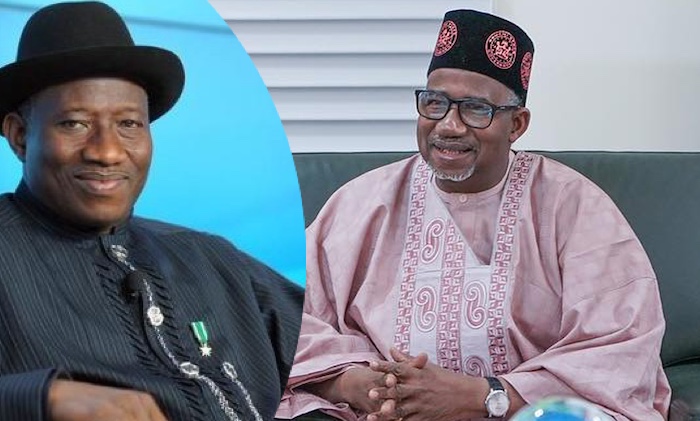

These days it is commonly discussed at virtually every political forum of the need to draft former President Goodluck Jonathan to contest the 2027 presidential elections as a most viable solution to the current political imbroglio facing the country. Vanguard Newspaper carried the issue conspicuously today. Whether this move will be a solution or by itself will be introducing another problem to our transitional politics is not what I am concerned with in this article. My concern here, beyond his suitability, is President Jonathan’s eligibility. Is President Jonathan eligible to contest another 4-year term in office? I think before this matter is taken any further, both by its agitators and by former President Jonathan himself, the legal question must have to be conclusively resolved.
As it is presently, there is the Justice Oniyangi’s FCT’s High Court judgment of March 2013 that explicitly cleared former President Jonathan to contest another term. There is, however, also a Supreme Court’s judgment on this matter forbidding a governor and a president to remain in office for a cumulative period exceeding eight years. And then now, there is the constitutional amendment of section 137(3) barring him from contesting.
On this eligibility question, I took PDP and former President Jonathan right up to the Supreme Court in 2014 for determination, but the apex court staunchly refused to hear and determine the suit; forcing a withdrawal on my counsel instead. And so Jonathan contested and lost in 2015. Now we are back to the same matter again. What is the constitutional status of former President Jonathan’s right to again contest for the presidency of Nigeria? In my layman’s viewpoint, I still think former President Jonathan’s presidential contest stands on very shaky legal grounds, to put mildly. As can be gleaned above through a layman’s lens, the most compelling legal bases lie on two grounds. First is on the Supreme Court’s interpretation of the 4-year tenure of two terms in the case of Marwa v Nyako in 2012. In that judgment, the apex court held that no person can hold the office of governor or president for more than eight years cumulatively. Jonathan served from May 6, 2010 to May 29, 2015 – a total of five years and twenty-three days. Should he return for another four-year term, he would breach the 8-year constitutional limit set by the Supreme Court, amounting to nine years and twenty three days in office.
In determining the issue of tenure in that case, the Supreme Court adopted two basic principles in its interpretation of the constitution in calculating the 4-year tenure of 2-term provision. On the one hand, that a Governor – and a President – is elected for four years and eligible to re-election for another four years and no more. On the basis of that the Supreme Court declared: “In all a governor (and president) has a maximum tenure of eight (8) years under the 1999 constitution. It is very clear from the relevant provisions that no person elected under the 1999 Constitution can remain in that office for a day longer than provided otherwise the intention of the framers of the constitution would be defeated,” and added pointedly that: “The 1999 Constitution has no room for self–succession for a cumulative tenure exceeding eight years.”
Explicitly, this means that the cumulative eight years tenure can be in bit and pieces, so to speak. It also means that in computing President Jonathan’s maximum of eight years tenure, the one year twenty three days he held as president between May 6, 2010 and May 29, 2011 will be counted. Other two points being made also are first, all tenures of office of the executive emanate from the two 4-year terms; and second, it really does not matter how one constitutionally comes into office, what matters is one does not remain in that office a day beyond cumulative eight years.
On the other hand, the Supreme Court adopts the principle that so long as “the acts performed during the period in office remain valid and subsisting,” then the oath taken empowering the performing of those acts also remains valid and becomes the starting point in calculating the cumulative eight years tenure of office. It is on record that all the acts President Jonathan performed between May 6, 2010 and May 29, 2011, including the Electoral Act that was used to re-elect him in 2011, are all valid and subsisting. Therefore, to calculate the tenure of office of President Jonathan from May 29, 2011 when he was sworn-in as duly elected President and ignore the period from May 6, 2010 when he was first sworn-in as President, is to close our eyes to what is real and concrete thereby extending for the former president a period in office beyond the maximum eight years tenure for the executive.
It is also worthy to note that former President Jonathan’s only claim of right to contest another term of four years is solely hinged on the disqualification clause in Section 137 sub-Section 1 (b) of the constitution that says: “if he has been elected to the office of president at any two previous elections”. This is the clause upon which Justice Oniyangi of the FCT High Court mainly based the argument of his judgment. It is true Jonathan was not elected as president at any two previous elections, but the question is, if electing a person two times will give him a cumulative period in office exceeding the eight years bracket, will he still be eligible to contest such two terms of four years to that office? I think the answer, to my understanding of the logic and conclusion of the Supreme Court judgment, is in the negative.
Besides, if Section 137 sub-Section 1 (b) is former President Jonathan’s only ‘qualification’ to contest, then same will be applicable to former Governors Boni Haruna of Adamawa, Rotimi Amaechi of Rivers and Ibrahim Gaidam of Yobe (who remained, albeit questionably, in office for about 11 years) States under Section 182 sub-Section 1 (b). Technically speaking, like former President Jonathan, these men were also not elected at any two previous elections as governors of their respective states. All of them, again like former President Jonathan, assumed office through some constitutional means after election and commencement of terms. Does it mean that they are all eligible to contest another term as governors of their states? Can we say that Gov. Yero of Kaduna State still has two more terms of 4 years to contest as governor? In my understanding of the Supreme Court’s judgment, I think none of them is eligible to exceed eight years in office.
In any case, any ambiguity on this issue should have now been explicitly resolved by the 2018 constitutional amendment, which is the second legal stance.
On the second legal stance, there is a constitutional amendment enacted and signed by former President Muhammadu Buhari specifically addressing the scenario where a vice president (or deputy governor) assumes office due to the death, resignation or removal of a president (or governor) and then seeks to contest that same office, like in the current case of President Jonathan. On June 8, 2018, President Buhari signed into law several constitutional alteration bills, including Constitution Alteration Bill No. 16. This particular amendment stipulates that if a Vice President assumes the presidency (say, due to the death, removal, resignation or incapacitation of the President), that individual – having effectively completed the remainder of the predecessor’s term (like former President Jonathan) – is eligible to contest for the presidency only one more time. The same rule applies at the state level: a Deputy Governor who takes over a Governor’s term may only contest the governorship one additional time. The relevant clause reads: “A person who WAS [upper case emphasis mine] sworn in as president to complete the term for which another person was elected as president shall not be elected to that office for more than a single term”.
This provision is clear without any evocation. The obvious implication is that someone (like President Jonathan) who is in such a succession position, having succeeded ‘Yar’adua and contested once more cannot run for office anymore; meaning effectively that he cannot contest again. No strategic convenience or political sentiment can override this constitutional sanctity.
If in 2014 the Supreme Court refused to determine my suit on this matter and allowed President Jonathan to run in 2015, the amendment of the constitution in 2018 has effectively barred him from ever contesting again, making any such contest unconstitutional. Though we may all have built our needs, interests, calculations, strategies, emotions and sentiments for or against former President Jonathan’s contest in 2027, but as the law stands now, in my layman’s view, his contest is explicitly prohibited.
In conclusion, while the call for former President Jonathan’s return may be politically motivated or emotionally driven, it is imperative that we uphold the rule of law over personal or partisan interests. The constitutional and judicial precedents outlined here leave little room for ambiguity. Both the Supreme Court’s interpretation in Marwa v Nyako and the clear provisions of Section 137(3) as amended in 2018 categorically restrict any individual from occupying the office of president for more than eight years in total, regardless of the mode of initial assumption. Therefore, unless the constitution is again amended, any attempt to draft former President Jonathan into the 2027 presidential race would be in direct violation of the law and a disservice to our democratic integrity. Let us, as a nation, move forward with a commitment to constitutional order and generational renewal in leadership.
Umar Ardo Ph.D., a consummate politician, was the SDP Adamawa State Governorship Candidate in the 2023 election. He lives in Abuja, Nigeria.