
Saturday, April 4, 2026
30.7 C
Abuja

GPS vs BeiDou: U.S. and China Compete for Satellite Navigation Dominance 

With rising trade and tech tensions between the U.S. and China, satellite navigation is becoming a new battleground. China’s BeiDou system, competing with the U.S. GPS, is securing its dominance domestically and replacing GPS on Chinese devices. In 2024, BeiDou generated 575.8 billion yuan (US$79.9 billion), marking a 7.39 percent increase from the previous year, according to the GNSS and LBS Association of China. 

China’s BeiDou satellite navigation system is compatible with 288 million smartphones, mainly from Huawei and Xiaomi. It tracks locations over 1 trillion times daily. Users in China use BeiDou to travel over 4 billion kilometers each day. The system is expanding from smartphones and in-vehicle navigation to wearables, drones, electric bikes, and robots. Its growth is also driven by restrictions on GPS in China. 

Chinese businesses use BeiDou for both land and maritime navigation. The system supports China’s expanding merchant navy, with most vessels, including Cosco’s, transitioning from GPS to BeiDou or using both. 

After solidifying its domestic market lead, BeiDou aims to challenge GPS’s global dominance. China sees foreign adoption of BeiDou as a boost to its soft power, aligning with the Belt and Road Initiative to promote its navigation system abroad. 

The China Satellite Navigation Office reports that BeiDou’s signals are widely accessible across Africa, Southeast Asia, the Middle East, and Latin America. The primary user base comprises the agriculture, transport, and infrastructure sectors. 

Furthermore, BeiDou indicates that the system is extensively utilized commercially for various applications, including port management in Pakistan, land planning and river transport in Myanmar, precision agriculture and pest control in Laos, urban planning in Brunei, and maritime patrols in Indonesia. 

Experts believe BeiDou has surpassed GPS in satellite count, signal strength, and positioning accuracy. BeiDou has 56 satellites compared to GPS’s 31, with BeiDou’s newer constellation. It also has ten times more global monitoring stations, enhancing its accuracy. BeiDou offers public positioning accuracy within one meter and military accuracy within one centimeter, whereas standard GPS typically provides accuracy within three meters. 

A Harvard Belfer Center paper stated that China’s BeiDou system surpasses GPS in technical aspects. Sarah Sewall and co-authors noted that BeiDou offers the most accessible and accurate Positioning, Navigation, and Timing (PNT) data globally. In 2020, Nikkei Asia reported BeiDou outperforms GPS in 165 countries. Despite this, GPS benefits from being widely used for years and deeply integrated with American technologies. 

Experts warn that systems like BeiDou can be used for surveillance, adding security concerns to China’s technology exports. While SatNav is crucial to daily life globally, it holds geopolitical significance and faces intense market competition. China developed its satellite navigation system to reduce reliance on U.S. technology, worried that in wartime, the US could restrict access, affecting military operations. SatNav has numerous military applications, including guided munitions and missiles. 

Hot this week

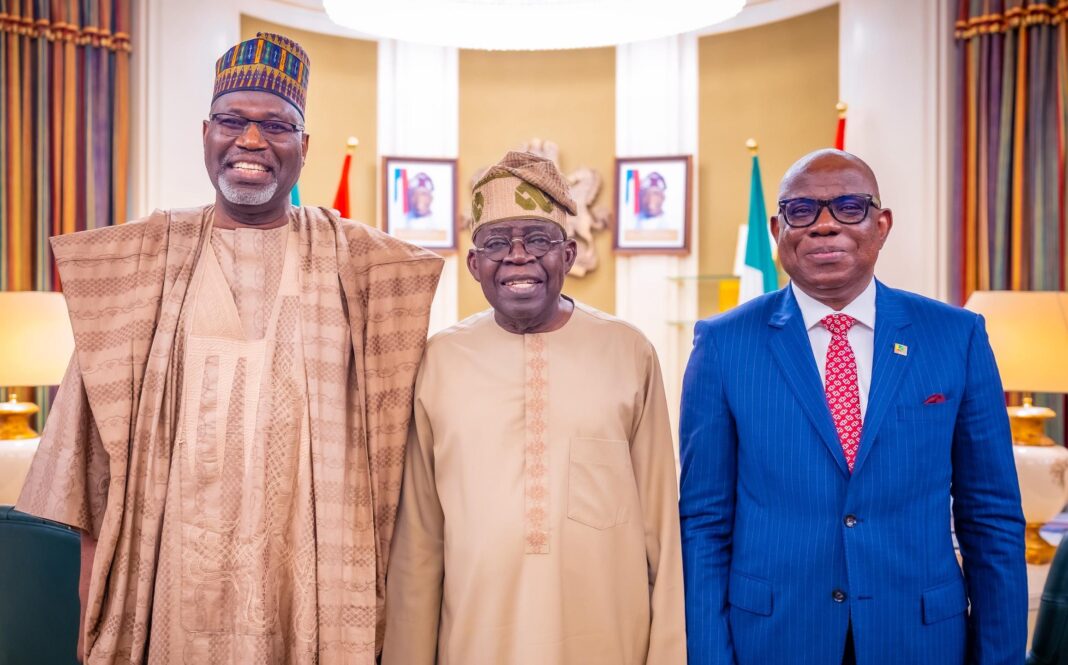
President Tinubu Felicitates NNPC Board Chair Musa Kida at 65

President Tinubu Felicitates NNPC Board Chair Musa Kida at 65

We Are Better Together: A Caution to the Advocates of Separation

It must first be clearly stated that the North’s preference for Nigerian unity is not because it is incapable of standing on its own, nor because it is uniquely dependent on the present federal arrangement for its existence. Historically, the North demonstrated a strong capacity for political cohesion and governance under the regional system, where the Caliphate produced the Premier and the Sultanate provided the Governor. With a vast, geographically contiguous landmass, a dominant lingua franca and largely shared religious and cultural frameworks, a substantial part of Northern Nigeria has historically functioned as a coherent political space.

PDP Disputes Ibadan Court, Affirms NWC Validity 

The PDP chairman noted that the Ibadan ruling was only one of several judgments of the Federal High Court on the matter and that the core issues were already before the Court of Appeal. He described the decision as “technically academic” pending an authoritative pronouncement by the appellate court. Turaki reassured party members that the National Working Committee produced by the Ibadan Convention remained “legally intact and firmly in place,” and committed to what he described as the party’s ongoing rebirth.

A Setback for Wike in PDP Crisis 

While the Supreme Court’s earlier intervention briefly revived Anyanwu’s standing, Tuesday’s dismissal signals that legal victories alone may no longer be enough to secure long-term control. The struggle within the PDP is increasingly shifting from courtrooms to internal political negotiations, and in that arena, the momentum appears to be slipping away from the Wike camp.

NNPC Ltd. Debt: FG Forgave Interest, Not Principal, Officials Say 

Fresh details have emerged that challenge the widespread belief that the...

Topics

President Tinubu Felicitates NNPC Board Chair Musa Kida at 65

President Tinubu Felicitates NNPC Board Chair Musa Kida at 65

We Are Better Together: A Caution to the Advocates of Separation

It must first be clearly stated that the North’s preference for Nigerian unity is not because it is incapable of standing on its own, nor because it is uniquely dependent on the present federal arrangement for its existence. Historically, the North demonstrated a strong capacity for political cohesion and governance under the regional system, where the Caliphate produced the Premier and the Sultanate provided the Governor. With a vast, geographically contiguous landmass, a dominant lingua franca and largely shared religious and cultural frameworks, a substantial part of Northern Nigeria has historically functioned as a coherent political space.

PDP Disputes Ibadan Court, Affirms NWC Validity 

The PDP chairman noted that the Ibadan ruling was only one of several judgments of the Federal High Court on the matter and that the core issues were already before the Court of Appeal. He described the decision as “technically academic” pending an authoritative pronouncement by the appellate court. Turaki reassured party members that the National Working Committee produced by the Ibadan Convention remained “legally intact and firmly in place,” and committed to what he described as the party’s ongoing rebirth.

A Setback for Wike in PDP Crisis 

While the Supreme Court’s earlier intervention briefly revived Anyanwu’s standing, Tuesday’s dismissal signals that legal victories alone may no longer be enough to secure long-term control. The struggle within the PDP is increasingly shifting from courtrooms to internal political negotiations, and in that arena, the momentum appears to be slipping away from the Wike camp.

NNPC Ltd. Debt: FG Forgave Interest, Not Principal, Officials Say 

Fresh details have emerged that challenge the widespread belief that the...

No Terrorists Were Killed in U.S. Strike on ‘ISIS’ in Nigeria 

Abu Jabo dismissed reports that terrorists were killed in the strike, stressing that Jabo has no history of insurgency or bandit activity. “There are no terrorists here. There are no Christians here either. Jabo is a peaceful, Muslim community. We do not have security problems,” he added. Local sources also dispute claims that the area harbors ISIS-linked elements, describing Jabo as a quiet farming settlement with no record of extremist activity.

Trump: U.S. Hit Terror Targets in Nigeria 

In a strongly worded statement posted on his verified social media account, Trump said the United States, acting under his direction as Commander-in-Chief, had launched “powerful and deadly” strikes against what he described as ISIS-linked terrorists operating in Northwest Nigeria. He claimed the operation was in response to the killing of Christians and warned of further military action if such attacks continued. 

NNPC Limited: Early Signals from the Kida–Ojulari Era 

As a non-executive chairman with decades of industry experience, Engr. Kida’s influence lies less in operational detail and more in direction-setting and discipline. The reconstituted board signals a renewed emphasis on corporate governance, professionalism and alignment with the spirit of the PIA, that NNPC Limited should operate as a business, not a government department. 
spot_img

Related Articles

Popular Categories

spot_imgspot_img