

Monday, February 16, 2026
34.1 C
Abuja

Israeli Airstrike in Qatar and the Dwindling Credibility of the U.S. 

In “Understanding International Credibility and Its Changes: Taking China as an Example,” Jiang Fangfei describes international credibility as how other nations assess a country’s trustworthiness in terms of capabilities and intentions. This credibility reflects both national actions and reputation within the global community.  

In the paper, Fangfei stated that the development, maintenance, and enhancement of a nation’s international credibility are contingent upon five key factors: robust hard power, effective comprehensive governance and contractual capacities, strong government credibility and domestic social cohesion, reliable foreign policies and behavior, as well as advanced international communication abilities and influence over public opinion. 

In statecraft, credibility is essential for advancing national interests. It relies on trust worthiness and consistency between a nation’s statements and actions. A credible nation fulfills its promises, respects treaties, and follows both international law and established norms. Building such credibility takes considerable time and steady conduct. 

In diplomacy, credibility enhances a nation’s ability to build alliances, deter opponents, and protect its interests without frequent use of force. High credibility ensures warnings are respected and agreements trusted, while low credibility weakens alliances and reduces influence. 

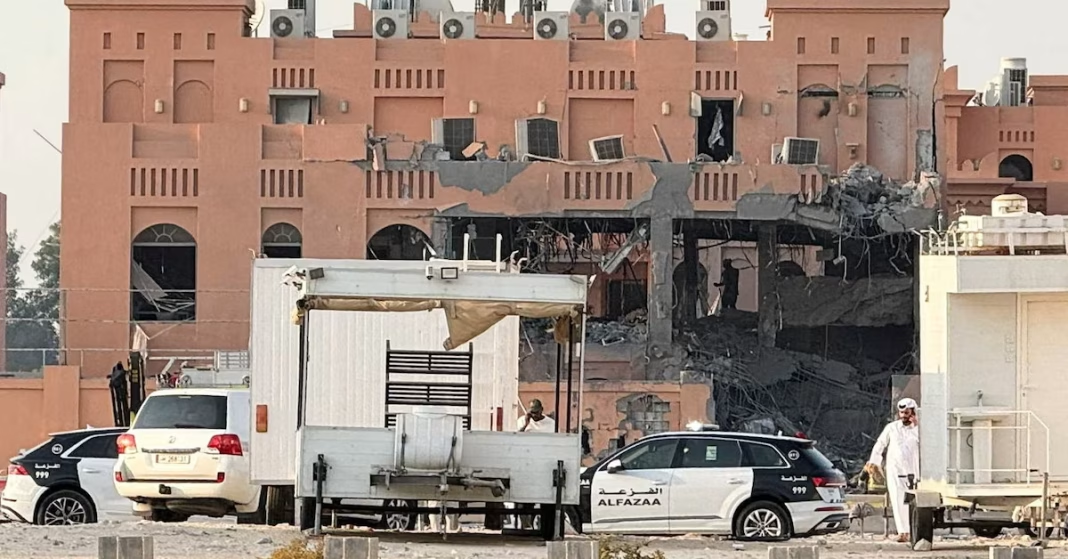
The reported bombing by Israel targeting Hamas leaders within Qatar highlights the complexities and considerations surrounding credibility in international relations.  

Israel’s military action on foreign territory without host nation approval, compounds its already dwindled credibility. Such actions are contrary to international law, present challenges to state sovereignty, and potentially complicate the U.S.-supported mediation efforts by Qatar to broker the release of Israeli hostages by Hamas and achieve a ceasefire that will cut down on the barbarous mass killings of Palestinians by the Israel Defense Forces (IDF). 

The Israeli airstrike has notably affected the credibility of the United States within international politics, especially in the Middle East. Taking place in the capital of a significant non-NATO U.S. ally and a principal mediator in the Israel-Hamas conflict, the strike has prompted concerns regarding a potential decline in U.S. influence. 

The U.S.  has historically relied on Qatar to host Hamas’s political office and facilitate negotiations as an intermediary. The recent strike, which occurred while Hamas leaders were reportedly reviewing a U.S.-supported ceasefire proposal, challenges Qatar’s sovereignty and its role as a neutral diplomatic center. Qatari officials expressed strong concerns, with the Prime Minister characterizing the incident as “state terror” and indicating that it has significantly diminished prospects for reaching a hostage agreement. 

The strike raises concerns about the U.S.’s reliability in protecting allies and upholding diplomatic commitments. Qatar, home to a major U.S. base, saw its security assurances ignored, which may prompt other countries to reconsider the U.S. as a dependable security partner. 

Although the U.S. government publicly stated that the strike “does not advance Israel or America’s goals,” reports indicate that the U.S. was notified of the attack beforehand. This may point to a discrepancy between the United States’ public statements and its actions, or possibly reflects limitations in its capacity to prevent actions it considers unhelpful. 

Some analysts, especially in the Arab world, think Israel would not have launched the strike without at least tacit U.S. approval. Whether or not that is true, the perception that the U.S. approved or could not prevent the attack harms its reputation. 

The recent attack has generated significant concern and heightened insecurity throughout the Persian Gulf region. Arab states that have worked to strengthen ties with the United States and Israel, including the UAE and Saudi Arabia, may now reassess the stability and advantages of these alliances. As a result, this incident may prompt these nations to further diversify their international partnerships by engaging more actively with countries such as China and Russia, rather than maintaining exclusive reliance on the United States for security support. 

Contrary to President Donald Trump’s posturing as a Nobel Peace Prize hopeful, the strike poses a risk to ongoing ceasefire negotiations and may contribute to a broader escalation of the conflict. Israel’s demonstrated readiness to target Hamas leaders in diverse locations effectively broadens the operational theater, which could prompt retaliatory measures from other actors in the region. 

In nutshell, the Israeli bombing of Hamas leaders in Qatar has been described by international observers as affecting perceptions of U.S. credibility. The incident has drawn attention to the scope of American influence over Israel and its implications for a U.S.-supported diplomatic initiative, as well as U.S. relations with regional partners. This development has prompted discussions about the U.S.’s role as a security guarantor and mediator in the Middle East. 

Mustapha Shehu, a graduate of The Fletcher School of Law and Diplomacy, currently serves as the Chief Executive Officer of Veritas Media Limited, based in Abuja, Nigeria

Hot this week

President Tinubu Felicitates NNPC Board Chair Musa Kida at 65

President Tinubu Felicitates NNPC Board Chair Musa Kida at 65

We Are Better Together: A Caution to the Advocates of Separation

It must first be clearly stated that the North’s preference for Nigerian unity is not because it is incapable of standing on its own, nor because it is uniquely dependent on the present federal arrangement for its existence. Historically, the North demonstrated a strong capacity for political cohesion and governance under the regional system, where the Caliphate produced the Premier and the Sultanate provided the Governor. With a vast, geographically contiguous landmass, a dominant lingua franca and largely shared religious and cultural frameworks, a substantial part of Northern Nigeria has historically functioned as a coherent political space.

PDP Disputes Ibadan Court, Affirms NWC Validity 

The PDP chairman noted that the Ibadan ruling was only one of several judgments of the Federal High Court on the matter and that the core issues were already before the Court of Appeal. He described the decision as “technically academic” pending an authoritative pronouncement by the appellate court. Turaki reassured party members that the National Working Committee produced by the Ibadan Convention remained “legally intact and firmly in place,” and committed to what he described as the party’s ongoing rebirth.

A Setback for Wike in PDP Crisis 

While the Supreme Court’s earlier intervention briefly revived Anyanwu’s standing, Tuesday’s dismissal signals that legal victories alone may no longer be enough to secure long-term control. The struggle within the PDP is increasingly shifting from courtrooms to internal political negotiations, and in that arena, the momentum appears to be slipping away from the Wike camp.

NNPC Ltd. Debt: FG Forgave Interest, Not Principal, Officials Say 

Fresh details have emerged that challenge the widespread belief that the...

Topics

President Tinubu Felicitates NNPC Board Chair Musa Kida at 65

President Tinubu Felicitates NNPC Board Chair Musa Kida at 65

We Are Better Together: A Caution to the Advocates of Separation

It must first be clearly stated that the North’s preference for Nigerian unity is not because it is incapable of standing on its own, nor because it is uniquely dependent on the present federal arrangement for its existence. Historically, the North demonstrated a strong capacity for political cohesion and governance under the regional system, where the Caliphate produced the Premier and the Sultanate provided the Governor. With a vast, geographically contiguous landmass, a dominant lingua franca and largely shared religious and cultural frameworks, a substantial part of Northern Nigeria has historically functioned as a coherent political space.

PDP Disputes Ibadan Court, Affirms NWC Validity 

The PDP chairman noted that the Ibadan ruling was only one of several judgments of the Federal High Court on the matter and that the core issues were already before the Court of Appeal. He described the decision as “technically academic” pending an authoritative pronouncement by the appellate court. Turaki reassured party members that the National Working Committee produced by the Ibadan Convention remained “legally intact and firmly in place,” and committed to what he described as the party’s ongoing rebirth.

A Setback for Wike in PDP Crisis 

While the Supreme Court’s earlier intervention briefly revived Anyanwu’s standing, Tuesday’s dismissal signals that legal victories alone may no longer be enough to secure long-term control. The struggle within the PDP is increasingly shifting from courtrooms to internal political negotiations, and in that arena, the momentum appears to be slipping away from the Wike camp.

NNPC Ltd. Debt: FG Forgave Interest, Not Principal, Officials Say 

Fresh details have emerged that challenge the widespread belief that the...

No Terrorists Were Killed in U.S. Strike on ‘ISIS’ in Nigeria 

Abu Jabo dismissed reports that terrorists were killed in the strike, stressing that Jabo has no history of insurgency or bandit activity. “There are no terrorists here. There are no Christians here either. Jabo is a peaceful, Muslim community. We do not have security problems,” he added. Local sources also dispute claims that the area harbors ISIS-linked elements, describing Jabo as a quiet farming settlement with no record of extremist activity.

Trump: U.S. Hit Terror Targets in Nigeria 

In a strongly worded statement posted on his verified social media account, Trump said the United States, acting under his direction as Commander-in-Chief, had launched “powerful and deadly” strikes against what he described as ISIS-linked terrorists operating in Northwest Nigeria. He claimed the operation was in response to the killing of Christians and warned of further military action if such attacks continued. 

NNPC Limited: Early Signals from the Kida–Ojulari Era 

As a non-executive chairman with decades of industry experience, Engr. Kida’s influence lies less in operational detail and more in direction-setting and discipline. The reconstituted board signals a renewed emphasis on corporate governance, professionalism and alignment with the spirit of the PIA, that NNPC Limited should operate as a business, not a government department. 
spot_img

Related Articles

Popular Categories

spot_imgspot_img